
|
Getting your Trinity Audio player ready...
|
If you have ever finished a Korean drama and immediately Googled “Where was this filmed?”, there is a high chance the answer was Jeju Island. For many international fans, the journey to Jeju does not start with a plane ticket. It starts on a screen.
Jeju is not just a filming location. It is a place where geology, mythology, history, and modern pop culture collide. This article explores why travel to Jeju after watching K-drama feels almost inevitable—and why the island deserves more than just a quick honeymoon stop.
The Birth of Jeju Island: Fire, Myths, and Deep Time
Jeju Island exists because the Earth decided to show off.
Around 2 million years ago, during the Pleistocene era, repeated volcanic eruptions beneath the sea pushed lava upward. Over time, those eruptions formed a massive volcanic island. Unlike explosive volcanoes, Jeju grew from shield volcano activity, where lava flowed gently but persistently.
At the center of it all stands Hallasan, South Korea’s tallest mountain at 1,950 meters. It is not just scenic. It defines the island’s climate, ecology, and culture.
Jeju’s landscape still wears its volcanic history proudly:
- Lava tubes (among the longest in the world)
- Oreum (small parasitic volcanic cones)
- Black sand beaches
- Basalt cliffs shaped by wind and waves
UNESCO recognized this geological value by designating Jeju as a World Natural Heritage Site as report wikipedia
Mythological Origins: The Samseong Shinhwa
Science explains how Jeju formed. Myth explains how people belong to it.
According to Samseong Shinhwa, three divine ancestors—Go, Bu, and Yang—emerged from volcanic craters and founded the island’s first society. This myth still influences local rituals and Jeju’s strong tradition of shamanism.
Early Human Settlement
Archaeological evidence shows that humans reached Jeju as early as 40,000 years ago during the Paleolithic era. At that time, lower sea levels connected Jeju to the Korean Peninsula, China, and Japan.
When the Ice Age ended around 10,000 years ago, rising seas turned Jeju into a true island. Neolithic communities soon followed. Sites like Gosan-ri, the oldest known Neolithic settlement in Korea, confirm this timeline.
A Timeline of Jeju’s History: Independent, Isolated, and Resilient
Jeju’s history does not follow the mainland’s script. Isolation shaped everything.
Ancient Era: Tamna, the Kingdom of the Sea
Jeju was once known as Tamna, an independent maritime kingdom. By the 5th century, Tamna maintained tributary relationships with Baekje, Silla, and Goguryeo, while trading actively with China and Japan.
Despite outside pressure, Tamna preserved autonomy for centuries. Sea routes protected it better than armies ever could.
Medieval Period: Annexation and Control
In 1105, the Goryeo Dynasty officially annexed Tamna and renamed it Jeju, meaning “province across the sea.”
The island faced further disruption during the 13th century Mongol invasions, when Jeju served as a naval base for nearly 100 years.
Under the Joseon Dynasty, control tightened. The government enforced isolation policies and used Jeju as an exile destination for political dissidents and scholars. Mainland travel remained restricted for locals.
This isolation preserved Jeju’s:
- Distinct dialect (now endangered)
- Matriarchal social structures
- Haenyeo (women free-divers)
Colonial and Early Modern Era
Japan annexed Korea in 1910, and Jeju suffered under colonial rule like the rest of the peninsula. After Japan’s surrender in 1945, Jeju came under the U.S. Army Military Government in Korea (USAMGIK).
Population shifts, refugee inflows, and political polarization soon followed.
Jeju After the Korean War: The 4.3 Incident and Its Legacy
No discussion of Jeju is complete without acknowledging its deepest wound.
The Jeju 4.3 Uprising (1948–1954)
The Jeju Uprising, which began on April 3, 1948, started as resistance against separate South Korean elections that many islanders believed would permanently divide Korea.
Tensions escalated after police violence against protesters in 1947. Leftist guerrillas launched attacks, but the government response proved devastating.
Verified investigations and government records show:
- 25,000–30,000 civilians killed (about 10% of the population)
- Most victims were non-combatants
- Entire villages destroyed under scorched-earth policies
- Thousands fled to Japan
The violence continued even during the Korean War (1950–1953) and formally ended only in 1954.
Silence, Then Recognition
For decades, speaking about the uprising remained taboo. That silence ended slowly.
In 2003, a national investigation officially acknowledged state responsibility. President Roh Moo-hyun issued a public apology. Today, the Jeju 4.3 Peace Park and Memorial preserve memory and education.
This history matters, especially as tourism grows. Jeju’s beauty should never erase its past.
Why K-Dramas Make People Want to Travel to Jeju
K-dramas do not sell Jeju as a backdrop. They sell it as a feeling.
Wide coastal roads signal freedom. Oreum hills suggest quiet healing. Tangerine fields whisper domestic happiness. Jeju becomes a character.
Why Watching K-Dramas Makes People Want to Visit Jeju Island
Feeling the urge to travel to Jeju Island after watching a K-drama is completely natural—and there are clear reasons behind it.
1. Breathtaking Locations
K-dramas showcase Jeju Island’s natural beauty in a cinematic way. The ocean views, volcanic mountains, lava tubes, tangerine orchards, and quiet beaches look almost unreal on screen. These visuals spark a desire to experience the same peace and adventure in real life.
2. Romantic and Emotional Atmosphere
Many dramas portray Jeju as a place of healing and emotional reset. Characters often come here to escape heartbreak, start over, or fall in love. That emotional storytelling creates the impression that Jeju offers the same calm and renewal beyond the screen.
3. Unique Local Culture and Traditions
Jeju’s distinct culture stands out in K-dramas. Viewers get glimpses of the island’s matriarchal society, the legendary haenyeo (women divers), and traditional local food. This cultural exposure naturally makes people curious about what Jeju feels like in everyday life.
4. The Influence of Favorite Actors
For K-drama fans, visiting filming locations feels personal. Walking where favorite actors once filmed scenes turns a regular trip into a meaningful experience. Jeju becomes more than a destination—it becomes part of a fan’s journey.
5. A Break from Everyday Routine
Dramas often present Jeju as an escape from crowded cities, traffic, and noise. Clean air, open landscapes, and a slower pace of life make the island look like the perfect place to disconnect and breathe again. Watching these scenes often leads to one simple thought: “I need to go there.”
In short, K-dramas transform Jeju Island into a place that feels magical yet real. That emotional connection is exactly why so many viewers end up thinking, “Let’s travel to Jeju Island.”
Popular Korean Dramas Filmed in Jeju
Some of the most influential dramas include:
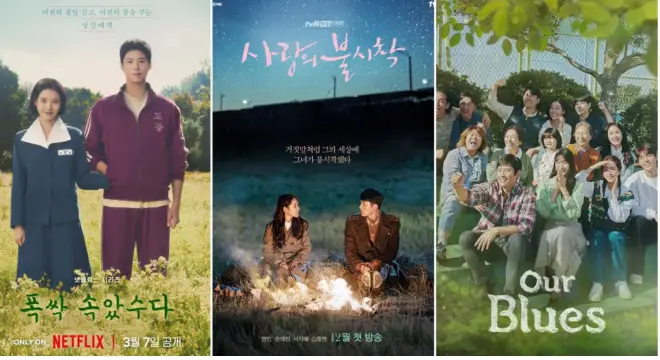
- Our Blues (2022) – Everyday life, haenyeo culture, emotional realism
- When Life Gives You Tangerines (2025) – Fully set in Jeju’s farms and fishing villages
- Welcome to Samdal-ri (2023–2024) – Small-town recovery and belonging
- Crash Landing on You – Iconic Hallasan and countryside scenes
- Extraordinary Attorney Woo – Temples and volcanic landscapes
- The Legend of the Blue Sea – Cliffs and coastal fantasy
- Warm and Cozy – Food, cafés, and romance
- Tamra, the Island – Historical Jeju and outsider tension
These dramas invite viewers to imagine life slowed down. That fantasy works remarkably well.
Traveling to Jeju After Watching K-Drama: Expectations vs Reality
Let’s be honest. Jeju is not one long romantic montage.
You will encounter:
- Strong winds that ruin hairstyles
- Steep hikes disguised as “short walks”
- Locals who value silence more than selfies
Yet that realism becomes part of the charm.
Jeju rewards travelers who:
- Respect local culture
- Learn basic island etiquette
- Visit beyond peak honeymoon seasons
The island balances modern tourism with deep-rooted tradition. That balance feels rare.
Jeju Today: Tourism, Identity, and Responsibility
Jeju became South Korea’s first Special Self-Governing Province in 2006, gaining administrative autonomy.
Tourism now drives the economy, with increasing demand for:
- Eco-friendly travel
- Personalized nature experiences
- Cultural tourism beyond beaches
Experts warn that unchecked growth risks diluting Jeju’s identity. Sustainable tourism matters here more than most places.
Final Thoughts: Jeju Is More Than a K-Drama Destination
Travel to Jeju after watching K-drama often starts with romance. It ends with respect.
The island tells stories through lava, loss, resilience, and reinvention. Dramas may open the door, but history keeps it meaningful.
Jeju does not ask visitors to fall in love blindly. It asks them to look closer.
And once you do, leaving becomes the hardest part.